


Orange: The Colour of Safety

For international productions filming in Vietnam, something as simple as a colour can determine whether a shoot moves with precision or unravels under pressure.

The CREATV Company — identity aligned with how productions operate on set.
On a new set, in a new country, the first few hours decide everything — not the camera, not the brief, but movement.
“Who goes where? Who follows? Who splits?”
Whatever’s written in the gear manifest, transpo grid, or call sheets will be tested immediately through company moves and logistical pressure. The slightest inconsistency equals lost time, and lost time quickly adds up to the unthinkable: lost days.
“Before anything becomes cinematic, it has to function.”
Before anything becomes cinematic, it has to function. When filming in an unfamiliar environment, this is often underestimated. Something as simple as colour starts to matter.

The consistency of colour over time reflects a shift from visual identity to operational tool.
You’ll notice one thing across our sets: orange. Not as branding, but as a signal. It appears where decisions need to be made quickly.
For international crews, hesitation is friction. Bottlenecks — especially when foreseeable and avoidable — are costly and demoralising. Crews need access, company moves need the fastest and most direct routes, and load-in/out must follow the path of least resistance. The sequence of events needs clear visualization to all hands on deck.
You don’t want people asking where to go, whether it’s to the gear room or the bathroom. You want them moving, reading the environment, working, using time wisely.
In a system limited by daylight and access, visibility becomes efficiency and, therefore, control. This principle isn't unique to production --- high-visibility colours are used across construction, aviation/aerospace and emergency response to reduce risk and improve reaction time.
"Visibility becomes efficency -- and efficiency becomes control."
Safety in production begins long before the first shot is taken. It lies in preparation — ensuring that crews are working within clear legal frameworks, with the documentation and logistical support in place. In Vietnam, this process has become increasingly streamlined in recent years, with faster permitting timelines, clearer regulatory pathways and improved coordination between local authorities and international production teams.
At CREATV, this foundation is central to how productions are supported. From securing working visas, fast-track entry and filming permits to managing customs clearance and equipment importation, the aim is to create a stable, predictable environment in which crews can focus fully on the creative process.
This way of thinking isn’t new to us. Our early work focused on documenting infrastructure development and electrification in Vietnam as the country entered a period of rapid industrial growth. We worked alongside companies such as BP Exploration during the construction of the country’s first LNG power projects.
Over the decades, that extended to large-scale infrastructure: from cable-stayed bridges captured through long-term time-lapse systems during the nation’s early move towards a modern, industrialised economy – to wind and solar energy projects filmed during Vietnam’s push towards net-zero carbon emissions.
These environments demanded clarity, structure, and safety, enforced through strict adherence to SOPs — systems we not only documented, but worked within daily.
Long before production systems, the focus was the same: how people move through unfamiliar, potentially hazardous environments — on land, at sea, and in the air.
Far from being mere appearance, design shapes and supports behaviour. Our Managing Director, Othello Khanh, grew up around this philosophy through the work of design and fashion figures Quasar Khanh and Emmanuelle Khanh, both widely recognised and frequently cited in international publications for their pioneering work.
Different disciplines. Same principle: design has to work in the real world.
The early years weren’t built as a system. In 2000, tools were limited.

Early identity built before the arrival of modern digital design tools in Vietnam.
“We didn’t even have Photoshop in Vietnam,” Othello recalls of the early aughts, when the company unveiled it’s 2nd gen logo (the first featured a softer shade of orange inspired by the saffron robes of Buddhist monks. “Design decisions were direct. You worked with what you had — often by hand — and pushed ideas through whatever machinery was available to produce results.”
As technology evolved, so did the expression: more tools, more effects, more complexity. Over time, there was a return to something simpler — keep what works, remove what doesn’t.
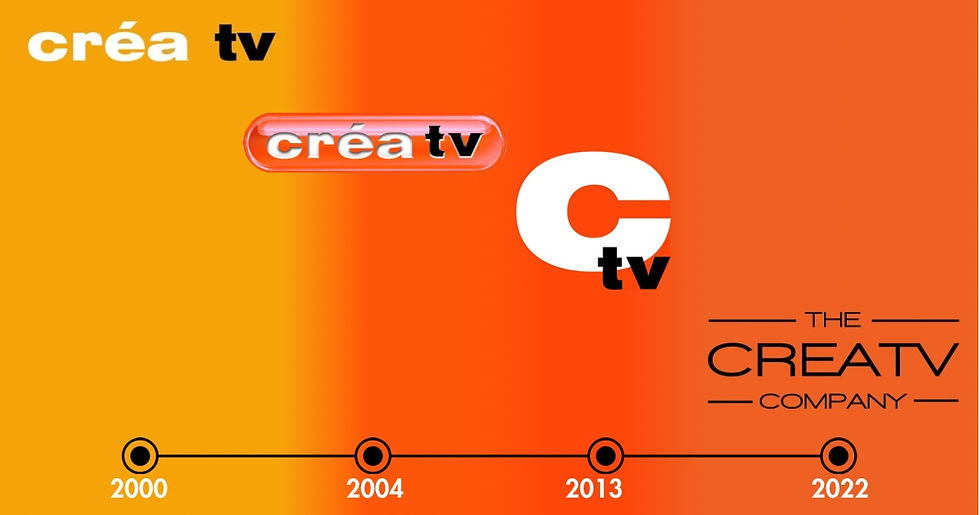
From early analogue workflows to today’s streamlined systems, the identity evolved alongside the industry.
The company evolved in parallel. From its early Francophone roots as “créa tv | creative television” to The CREATV Company. These were not cosmetic changes, but reflections of shifts in both the industry and wider viewing culture. As “television” transformed beyond recognition, it no longer defined the work, and was ultimately removed from the name entirely to emphasize the spectrum of visual storytelling under the banner of the “Creative Company”.
"Orange isn't branding. It's a signal."
As interest in filming in Asia hits a near historic high, we have introduced our CREATVAsia initiative to make the best of the astonishing world of locations in our backyard.
What remains is the current system: one colour, used deliberately. Not as decoration, but to support how a production moves.

Today, the system is reduced to what matters: clarity, visibility, and control.
"Cinematic work doesn't come from scale. It comes from control."
Over time, orange stopped being a design choice. It became part of how we operate.
On set, safety isn’t an add-on. It’s built into how a production runs.
Cost-efficiency isn’t about spending less. It’s about losing less — time, clarity, momentum.
Cinematic work doesn’t come from scale, but from control. The colour is simply the visible part of that system.
Safe. Cost-efficient. Cinematic. That’s the system. Welcome to Vietnam


Comments